

table of contents
The Mobile Speed Advantage: An Introduction to Performance Budgets
In today’s mobile-first world, speed isn’t a luxury—it’s a necessity. Users expect instant access to information on their smartphones, and if your website isn’t up to the task, they’ll quickly move on. A 2019 Google survey revealed that 75% of smartphone users expect immediate information. For businesses wanting to connect with mobile audiences, speed must be a top priority. This is where performance budgets come in.
The Impact of Mobile Speed
The benefits of a fast mobile experience extend far beyond user satisfaction. They have a direct impact on your bottom line: faster loading times translate directly into higher conversion rates, increased customer engagement, and improved search ranking. Even a 0.1-second improvement can significantly impact your sales figures, as demonstrated by eBay’s experience with “add to basket” clicks. Google also considers user experience, including page load speed, as a ranking factor, making a fast site crucial for visibility.
Three Steps to Mobile Speed Success
Achieving mobile speed requires a strategic approach. Here are three essential steps:
-
Measure Your Speed: You can’t improve what you don’t measure. Start by selecting the right tools and focusing solely on metrics that directly impact site speed. For example, key metrics to track might include Page Weight, Average Image Size, Page Load Time, and Number of HTTP Requests. Prioritise these and other relevant performance indicators across all teams to ensure a unified understanding and consistent tracking. Critically, test your site under real-world network conditions, not just in a controlled environment, to get an accurate picture of how your site performs for real users.
-
Optimise Graphics: Images and videos can significantly impact performance. Collaborate with your marketing team to remove unnecessary visuals and auto-playing carousels. Crucially, optimise images and videos for mobile devices, avoiding the use of desktop-sized files.
-
Implement a Performance Budget: Mobile speed is an ongoing process, not a one-time fix. A performance budget helps you maintain consistent performance over time.
What is a Performance Budget?
A performance budget is a set of defined limits for specific metrics that influence site performance, much like a financial budget. You establish limits for elements like page size, load time, and image size, and then work to stay within those boundaries.
Example Performance Budget:
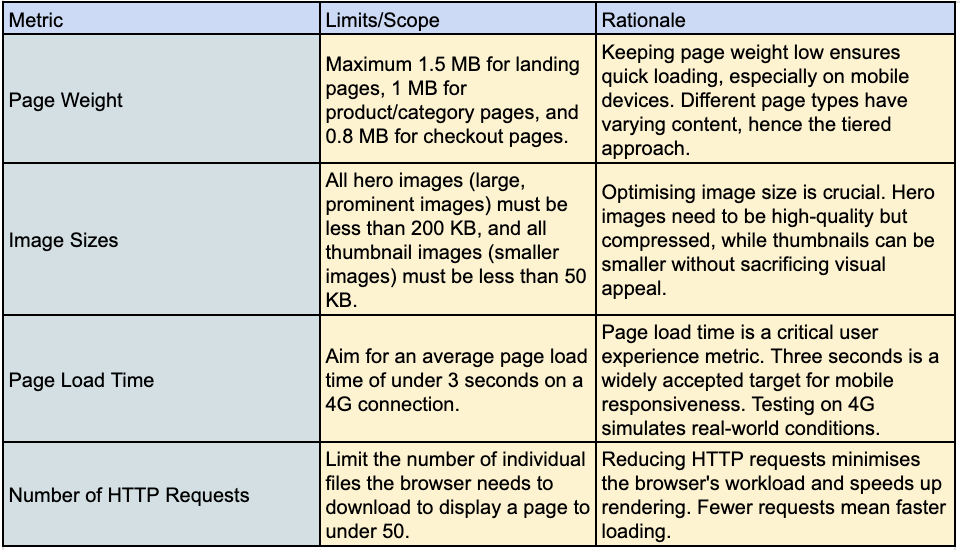
Practical Implications and Trade-offs
Adhering to your performance budget requires careful planning and sometimes, making strategic trade-offs.
Practical Implications
To achieve optimal website performance, several key areas require attention:
- Image Optimisation: Compress images and use modern formats like WebP. Implement lazy loading.
- Code Optimisation: Minify HTML, CSS, and JavaScript.
- Third-Party Scripts: Evaluate and optimise or remove unnecessary scripts.
- Caching: Utilise browser caching to minimise download times.
Trade-offs
Staying within page weight budgets may necessitate strategic decisions, such as:
- You may need to reduce the number of images or videos on certain pages.
- You might simplify the design of your mobile site.
The Bottom Line: Speed Drives Success
By prioritising mobile speed and implementing a performance budget, you can create a fast, engaging mobile experience that drives conversions, improves search ranking, and ultimately boosts your revenue. Don’t let slow loading times cost you valuable customers.
Want to Learn more About Mobile Experience?
Check out our blog on Why User Mobile Experience is Crucial to Your Conversion Rate.
Want to Learn About Digital Analytics?
For more digital analytics content, check out our blog on FBCLID (Facebook’s Click Identifier) and how it impacts GA4 data or How to Add a Google Ads Conversion Linker tag. If you have any questions or there’s anything else we can help with, please leave a comment below, or email contact@glowmetrics.com.
You can also stay up-to-date by following GlowMetrics on Twitter or LinkedIn or by subscribing to our newsletter (link below) for the latest tips and news in the world of digital analytics and marketing.
Don’t forget to sign up for a FREE account on our Resource Hub to access a wealth of valuable resources, including exclusive Google Tag Manager how-to videos and insights!